Metasurfaces hold significant application potential in polarization-multifunctional optical systems and devices, enabling the realization of various advanced optical functionalities at the subwavelength scale, such as spin multiplexing, optical waveplates, vectorial holography, Poincaré beams, etc. These functionalities require metasurfaces to simultaneously encode the polarization state, amplitude, and phase of the optical field. To achieve this crucial optical characteristic, the most effective approach is to precisely arrange a series of linearly birefringent elements (LBEs)—a type of element capable of generating distinct phase responses for orthogonally linearly polarized light. An ideal LBE should meet the following criteria: the highest transmittances, the maximum phase coverage range, and the lowest phase-correlation of the orthogonally linear polarizations.
Early LBEs were realized using metallic antennas, liquid crystals, or dielectric subwavelength gratings. However, these structures are inherently limited in either optical efficiency or phase coverage. In recent years, high-refractive-index truncated waveguide-based dielectric nanopillars with elliptical or rectangular cross-sections have emerged as a highly promising alternative. In this configuration, the x/y linearly polarized phase responses of the LBEs are determined by the propagation constants of the TM/TE waveguide modes. Nevertheless, due to configurational constraints, both responses vary synchronously with changes in any geometric parameter, leading to a high phase-correlation. Furthermore, near-field coupling between adjacent waveguides exacerbates the reduction in optical efficiency. Although LBEs with additional geometric parameters (e.g., cross-shaped, L-shaped, Z-shaped, T-shaped, and free-form nanopillars) coupled with advanced optimization techniques can mitigate these issues to some extent, the fundamental limitations at the physical mechanism level remain unaddressed.
To construct ideal LBEs, Professor Xinbin Cheng and Professor Zhanshan Wang from the School of Physics Science and Engineering at Tongji University, in collaboration with Associate Researcher Zhiyuan Jiang from the National Institute of Metrology of China, have proposed a novel mechanism for the phase decoupling of orthogonal linearly polarized light based on directional perturbation-driven metasurfaces. Inspired by the polarization-selective characteristics of mode coupling in adjacent dielectric waveguides, two adjacent waveguide-type dielectric nanopillars are used to construct the LBE—wherein the secondary waveguide acts as a perturbation, selectively modifying the mode field distribution of the primary waveguide. This directional perturbation enables the independent control of the short axis-polarized phase response of the primary waveguide by varying a single geometric parameter, while the long axis-polarized phase response remains completely unchanged. This method allows for the free encoding of wavefronts while generating arbitrary linear birefringence. Furthermore, the significantly enhanced ability to localize the optical field can effectively mitigate near-field coupling between adjacent meta-atoms, thereby improving the optical efficiency.
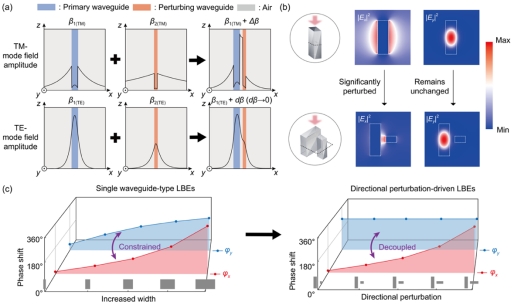
Figure 1. Directional perturbation-driven strategy. (a) The amplitude distributions of the TM and TE modes in the planar waveguides, both prior to and following the application of perturbation. β represents the propagation constant of the waveguide mode. Light transmits along the z-axis and the waveguide extends infinitely along the y-axis. (b) Schematic of the directional perturbation-driven LBEs. (c) Independent control of the orthogonally polarized phases using perturbation-driven meta-atoms.
Based on the proposed innovative concept, the paper demonstrates in sequence full Poincaré sphere waveplates, an anomalous refractive quarter waveplate, and a polarization-sensitive off-axis cylindrical metalens. Taking the anomalous refractive quarter waveplate as an example, the directional perturbation-driven metasurface exhibits significant improvements in both diffraction efficiency (88%) and polarization conversion efficiency (91%) compared to the traditional rectangular dielectric nanopillar metasurface (74% and 62%, respectively). The experimental characterization results are in good agreement with the theoretical predictions.
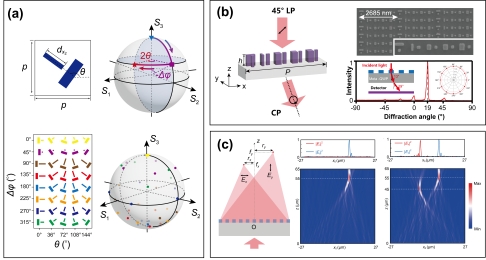
Figure 2. Optical functionalities demonstrated based on the directional perturbation-driven metasurfaces. (a) Full-Poincaré-sphere waveplate. (b) Anomalous refractive quarter waveplate. (c) Polarization-sensitive off-axis cylindrical metalens.
This work proposes an innovative method for independent control of orthogonally polarized phases, addressing the performance bottlenecks of excessively high phase-correlation and low optical efficiency in existing approaches. Theoretically, it can be applied to all metasurface devices with polarization control functions, and exhibits excellent application potential in compact, high-performance polarization optical systems and devices.
This work, titled “Directional Perturbation-Driven Independent Control of Orthogonally Polarized Phases in Metasurfaces”, was published in the journal Nano Letters and selected for the Supplementary Journal Cover. Assistant Professor Tao He from Tongji University, Associate Researcher Zhiyuan Jiang from the National Institute of Metrology of China, and Professor Xinbin Cheng from Tongji University serve as the corresponding authors of the paper. Chao Feng Postdoctoral Fellow Chao Feng and Assistant Professor Tao He from Tongji University are the co-first authors. Other collaborators who made outstanding contributions to the paper include Assistant Professor Jingyuan Zhu, Assistant Professor Siyu Dong, Associate Professor Zeyong Wei, Professor Yuzhi Shi, and Professor Zhanshan Wang.
Relevant paper link
https://doi.org/10.1021/acs.nanolett.5c03429