Recently, a groundbreaking study led by Prof. Yuzhi Shi from the research team of Profs. Zhanshan Wang and Xinbin Cheng at the School of Physics Science and Engineering, Tongji University, has enriched the conventional understanding of optical torques (OTs). The team discovered a novel mechanism where spin angular momentum (SAM) gradients induce measurable OTs on non-absorbing, symmetric dielectric spheres. This work, titled “Optical Torques on Dielectric Spheres in a Spin-Gradient Light Field,” has been published in the prestigious journal Laser & Photonics Reviews, which has also been selected as the cover.

Light carries SAM, which transfers momentum to particles, generating OTs. Traditional OT generation relies on either absorbing spheres (e.g., gold nanoparticles) or anisotropic particles (e.g., rods or dumbbells). These approaches, however, face limitations such as thermal damage risks and restricted material compatibility.
To challenge the above long‐lasting understanding, the team proposed a novel mechanism where the OT originates exclusively from the SAM. By tightly focusing a circularly polarized beam into a line-shaped beam, they created a spin-gradient field (Figure 1b). The SAM intensity decays radially from the beam center (Figure 1c), generating non-uniform Poynting vector distributions on dielectric spheres. These uniquely distributed force vectors induce distinct patterns of total optical lateral forces (OLFs) from the opposite gradients of SAM, while spin‐gradient OTs maintain consistently the same sign (Figure 1d). The sign of the spin‐gradient OT also remains unaffected by the change in size, while it exhibits a sinusoidal relationship with the polarization, as shown in Figure 1e.
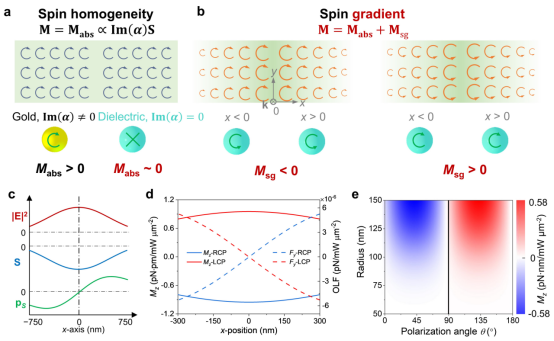
Figure 1. Optical torques on dielectric spheres in a spin-gradient light field.
Experimental validation required overcoming the inherent challenge of observing rotation in perfectly symmetric spheres. The team ingeniously labeled polystyrene microparticles (10 μm diameter) with fluorescent dyes, forming “tiny tails” for tracking (Figures 2a and b). Despite dye deactivation under high laser power (500 mW), residual markers allowed real-time rotation monitoring without perturbing optical forces. Experiments demonstrated instantaneous OT and OLF reversal upon polarization switching (Figures 2c-e), showcasing its strong correlation with light polarization.
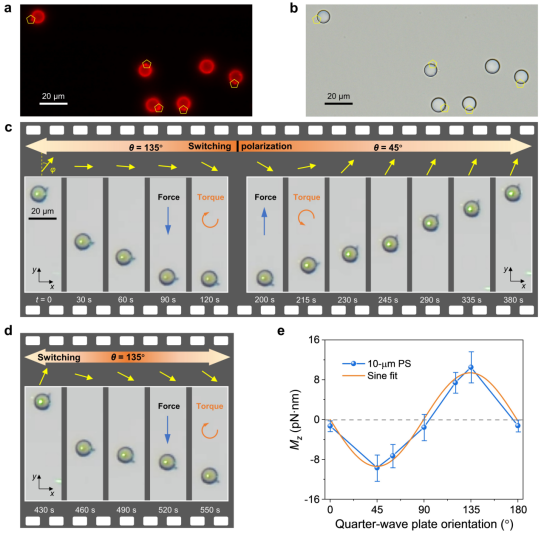
Figure 2. Experimental demonstration of polarization-controlled OTs.
This work elucidates light-matter interactions in spin-gradient fields, advancing the fundamental physics of optical manipulation. The system for exploring this extraordinary spin‐gradient OT is not limited to this type of beam. Various systems such as vector beams, evanescent waves, are possible candidates for leveraging this spin‐gradient OT. It also finds significant applications in biophysics, quantum sciences and metaoptics.
Corresponding authors are Profs. Xinbin Cheng, Zeyong Wei and Yuzhi Shi from Tongji University, and Prof. C. T. Chan from Hong Kong University of Science and Technology. Co-first authors include PhD candidate Haiyang Huang (Tongji University) and Assoc. Prof. Pin Chieh Wu (National Cheng Kung University). Key contributors encompass Prof. Zhanshan Wang, Prof. Tao He, PhD candidates Weicheng Yi, Chengxing Lai, Hong Luo (Tongji University), Prof. Qigang Wang, Assoc. Prof. Xia Wang, PhD candidate Manting Jin (Tongji University), Dr. Xiang Wu (Fudan University), Assoc. Prof. Bo Wang (Shanghai Jiao Tong University), and Assoc. Prof. Qinghua Song (Tsinghua University).