Recently, Associate Professor Zeyong Wei and Professor Yuzhi Shi from Professors Zhanshan Wang and Xinbin Cheng’s team at the School of Physics Science and Engineering, Tongji University, in collaboration with Professor Din Ping Tsai from City University of Hong Kong achieve broadband, wide-angle, and versatile metasurface illusions with inverse synthetic aperture radar imaging. This work proposes a feasible illusion strategy, opening up a new path for illusion design under wide bandwidth and wide angle, and promoting the practical application of illusion research. The related research entitled “Broadband, Wide-Angle, and Versatile Metasurface Illusions with Inverse Synthetic Aperture Radar Imaging” have been published in “Advanced Science” and selected as inside back cover.
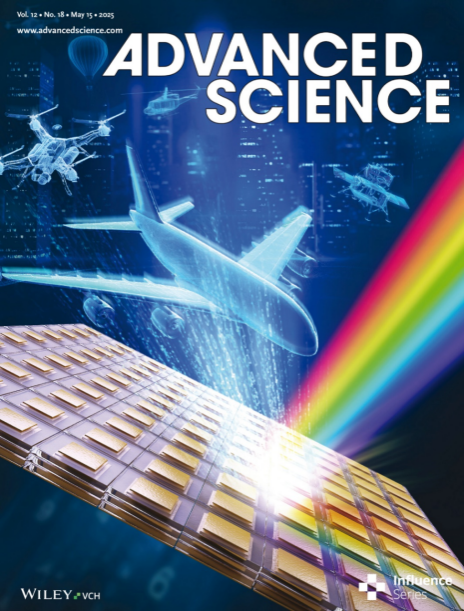
“Illusion” is a captivating topic throughout human civilization. It refers to a camouflage technique that allows the human eyes or electromagnetic wave detectors to perceive one object as another, perfectly illustrating the concept of “what you see is not what you get”. In recent years, the related research on metasurfaces has promoted the further development of illusion research. The scattering field can be reconstructed by designing metasurfaces to achieve the effect of illusions. However, most of the reported single-layer illusion metasurfaces are designed with a fixed phase gradient distribution at the target frequency, and usually operate only in a narrow frequency band and at a specific incident angle. Furthermore, current research usually designs and evaluates the quality of the illusion effects by discussing the distribution of near-field or far-field electromagnetic fields, which makes the illusion research still face many difficulties in the design process and practical application.
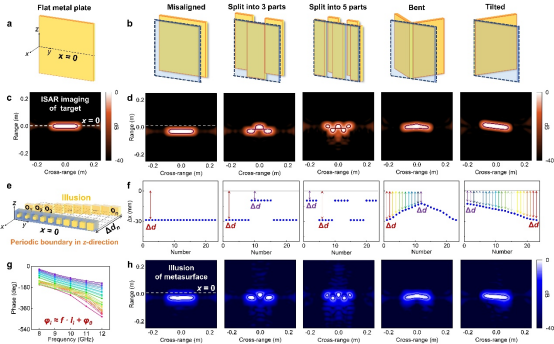
To address this issue, the research team propose a nontrivial illusion concept based on the inverse synthetic aperture radar (ISAR) imaging process. By processing the scattering information over a broadband and wide-angle range, a 2D ISAR image containing important feature information such as the shape and position of the target can be obtained, enabling direct target identification. The relationship between the broad-band phase dispersion of meta-atoms and the position of the illusions in ISAR image is constructed. By designing the size parameters and spatial positions of the unit structure, the position of the illusion structure in the ISAR image can be precisely and freely controlled.
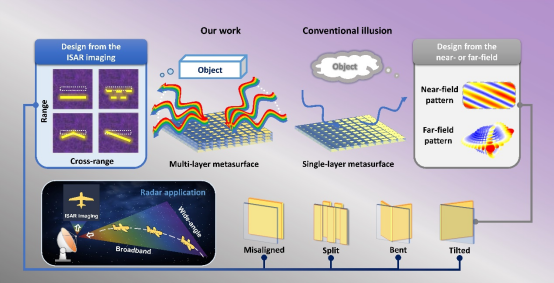
Various illusion examples of misalignment, splitting, bending, and tilting of metal flat plates are demonstrated by metasurfaces in broad-band (8 to 12 GHz) and wide-angle (-30° to 30°) ISAR imaging. This study expands the bandwidth and angular range of the illusion research work. It further broadens the scope and depth of illusion research in terms of design methods and implementation effects, providing new ideas and directions for applications and development in related fields.
Ph.D. student Haoran Li from Tongji University and Lecturer Kang Luo from National Key Laboratory of Electromagnetic Energy, Naval University of Engineering are the co-first authors of this paper. Associate Professor Zeyong Wei, Professor Yuzhi Shi, Professor Xinbin Cheng from Tongji University and Professor Din Ping Tsai from City University of Hong Kong are the corresponding authors of the paper. Other authors who made significant contributions include master student Yulang Li, Ph.D. student Linyuan Dou, Ph.D. student Shuqiao Li, Assistant Professor Tao He from Tongji University, Professor Yuancheng Fan from Northwestern Polytechnical University, Assistant Professor Mu Ku Chen from City University of Hong Kong and Professor Zhanshan Wang from Tongji University.
Paper link: https://doi.org/10.1002/advs.202416172